
Nigeria’s political landscape has been thrown into further uncertainty as the African Democratic Congress (ADC) faces a deepening leadership crisis. What was intended to be a unified “mega-coalition” against the ruling All Progressives Congress (APC) has instead devolved into a high-stakes legal and internal battle, threatening to derail the opposition’s strategy for the January 16, 2027, general elections.
The Battle for the ADC “Soul”
The friction reached a tipping point this week following a decisive move by the Independent National Electoral Commission (INEC). Acting on a Court of Appeal order, INEC formally removed former Senate President David Mark as the National Chairman and former Osun State Governor Rauf Aregbesola as the National Secretary from its official records.
The dispute stems from a power struggle initiated by Nafiu Bala Gombe, the party’s Vice National Chairman, who declared himself the acting chairman. Gombe successfully argued in court that party protocols entitled him to the position following previous resignations, despite the ADC’s claims that Gombe had himself resigned in May 2025.
A Coalition of Giants Under Siege
The ADC has recently emerged as the primary vehicle for Nigeria’s “Third Force.” In late 2025 and early 2026, the party attracted some of the most prominent names in Nigerian politics:
- The Big Four: Former Vice President Atiku Abubakar, former Anambra Governor Peter Obi, former Rivers Governor Rotimi Amaechi, and Rabiu Kwankwaso have all aligned with the ADC platform.
- The “Mega-Party” Goal: The strategy aimed to consolidate the supporters of the PDP, Labour Party (LP), and NNPP into a singular, formidable front.
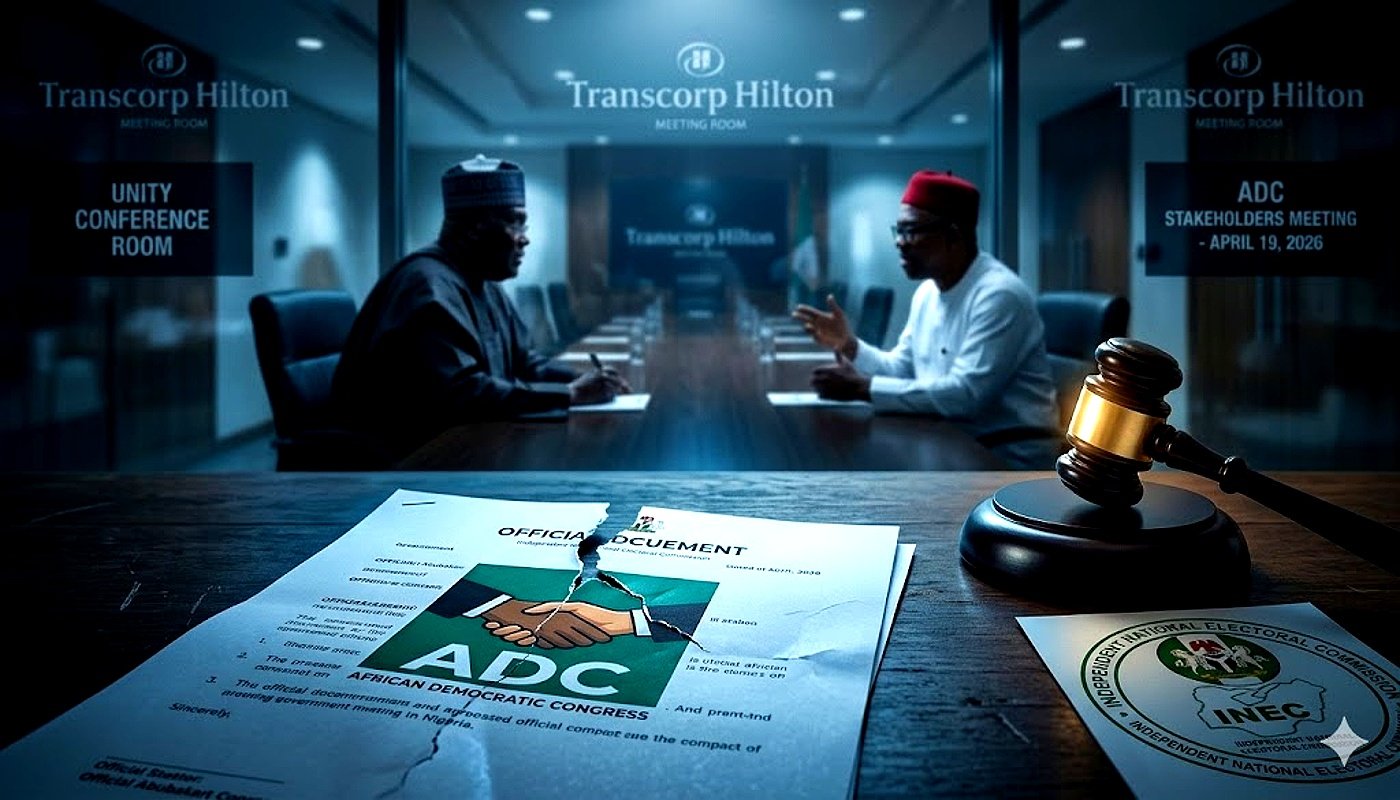
However, the “handshake” logo of the ADC is currently being tested by what party chieftains call “external sabotage.” During a recent joint press conference at the Transcorp Hilton, Atiku and Obi warned that the internal crisis is an attempt to “privatize” the opposition by the ruling party, an allegation the APC has repeatedly denied as “unfounded.”
Convention Drama at the Rainbow Event Centre
The leadership vacuum cast a long shadow over the ADC National Convention held in Abuja earlier this week. In a dramatic series of events, the party was denied access to traditional venues like Eagle Square and the Moshood Abiola National Stadium.
Despite being forced to relocate to the Rainbow Event Centre, ADC chieftain Kola Ologbondiyan maintained that the convention was a success, ratifying internal structures across all 36 states. However, critics within the party point to the lack of recognized national leadership as a major hurdle for the upcoming party primaries, scheduled by INEC to run from April 23 to May 30, 2026.
The Road to January 2027
With the presidential election less than a year away (January 16, 2027), the ADC’s inability to stabilize its leadership could have catastrophic results for the opposition. As inflation remains high and economic reforms continue to bite, voter appetite for a credible alternative is at an all-time high.
Political analysts suggest that if the ADC cannot resolve the David Mark-Nafiu Gombe standoff in the Supreme Court—scheduled for a hearing this Tuesday—the “Third Force” may fracture before the campaign season even officially kicks off in August. For now, the ADC remains a house divided, fighting a legal war on one front and a political war on the other.

As a contributor to digital news portals, I create content that highlights real-world experiences and evolving viewpoints. My writing combines clarity with relevance to engage readers effectively. I am committed to delivering content that is both informative and relatable.